
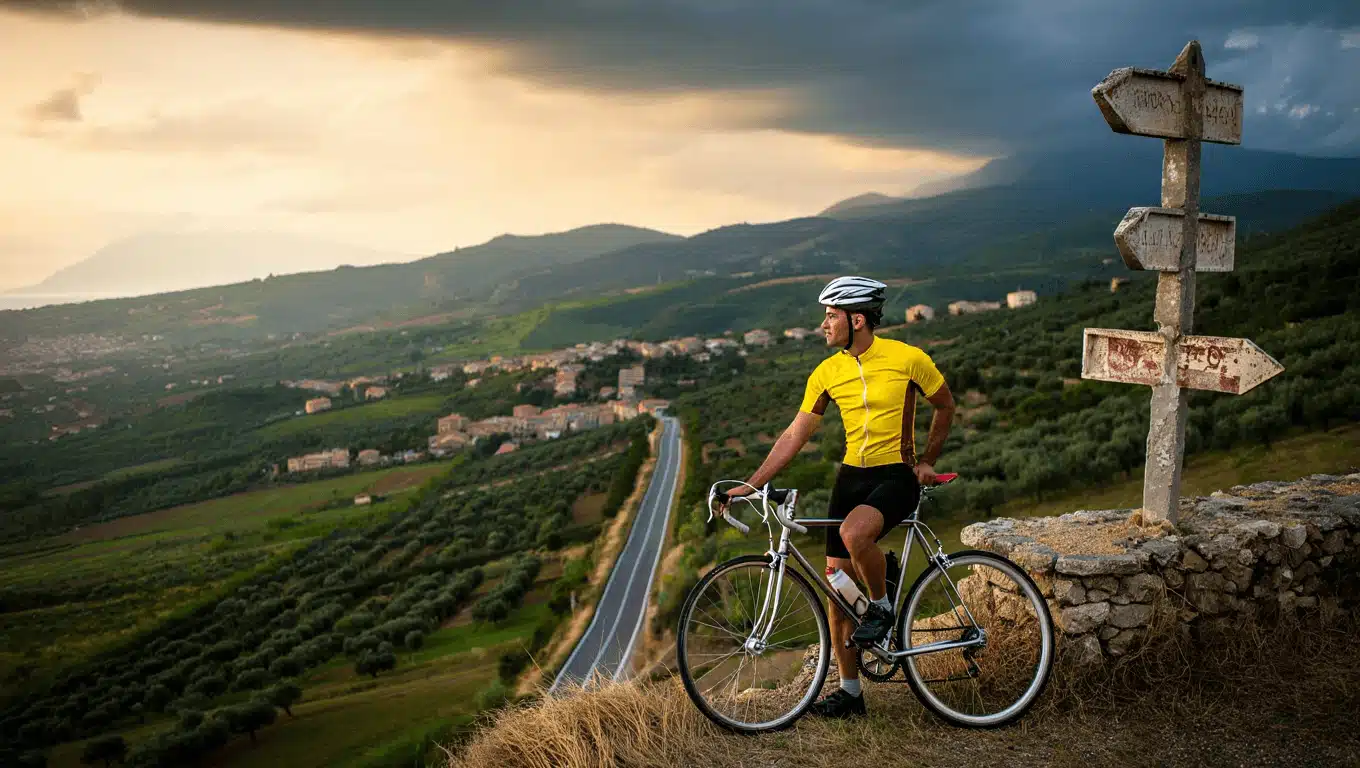
If you’re looking to escape Sicily’s coastal crowds and see the island on two wheels, a seven-stage cross-island route is reshaping how people travel there. The Sicily Divide — mapped during the pandemic and offered free to cyclists — threads quieter villages, steep climbs and farmland between Trapani and Catania, and it’s becoming a model for sustainable, experience-driven tourism.
What the Sicily Divide does differently
The route avoids seaside resorts and tourist chokepoints, pushing riders into the island’s interior where agriculture, small towns and local traditions dominate. Rather than a handful of crowded attractions, cyclists encounter vineyards, olive groves and smallholders’ markets; the payoff is steady, authentic contact with daily Sicilian life.
Developed by Palermo-based cyclists Giovanni Guarneri and Danuta Kanicka, the Sicily Divide is designed to do more than entertain: it funnels visitors into communities that have long been losing young people and jobs, helps reduce car traffic by promoting bike travel, and distributes tourist spending beyond the usual hotspots.
Route basics
The traverse runs roughly west-to-east across Sicily — from Trapani on the Tyrrhenian coast to Catania on the Ionian shore beneath Mt Etna. The full itinerary covers about 460 km over seven stages, with almost 9,000 m of ascent. Daily distances are flexible but average close to 65 km, mostly on secondary roads and some compacted gravel.
The standard stage endpoints include small towns such as Gibellina, Sambuca di Sicilia, Santo Stefano Quisquina (or nearby Bivona), Montedoro, Enna and Regalbuto — places chosen for their welcoming B&Bs and local services rather than for touristic spectacle.
Why it matters now
Travel patterns shifted dramatically after 2020: more people seek slower, less-crowded trips that benefit local economies and limit environmental pressure. The Sicily Divide responds directly to that demand. By opening up the island’s interior and linking locally run accommodations into a coherent route, it offers an alternative to mass tourism that has strained parts of Sicily’s coast.
- Revives small towns by bringing visitors and revenue to off-the-beaten-path communities
- Encourages longer stays and deeper cultural engagement than single-day day trips
- Supports lower-impact travel by favoring bikes over cars for cross-island movement
Navigation, accommodation and local connections
The route’s organizers provide free GPX tracks for navigation, so cyclists can ride independently without hiring a guide. A network of partner guesthouses, B&Bs and “bike-friendly” hotels appears at the end of each stage, making nightly planning straightforward.
Riders can also pick up a Divider’s Pass — a passport-style booklet for collecting stamps from cooperating hotels, restaurants and cafes. It’s a simple tool to connect visitors with businesses that support the project and to create a tangible record of the trip.
Terrain and the right bike
Expect mixed surfaces and frequent climbs. The interior of Sicily is uneven: long ascents, technical descents from hilltop villages and stretches of packed gravel. That variety makes a gravel bike the sensible choice — a machine built to marry road-bike efficiency with off-road resilience, and usually fitted with tyre widths in the 38–45 mm range and luggage mounts for multi-day packing.
When to go
Avoid height of summer. July and August bring both intense heat — often above 30°C (86°F) — and the island’s busiest holiday crowds. The best windows are the shoulder months: late spring (May–June) and early autumn (September–October). Mid‑April can also be ideal for milder temperatures and quieter services, though nights may be cool in hilltop villages.
Packing essentials (practical checklist)
Pack light but cover the basics. Below is a compact list that balances riding needs, comfort and repair capacity.
- Riding kit: helmet, cycling shoes, 1–2 jerseys, 1–2 bibs/shorts, sunglasses, sunscreen
- Weather layers: lightweight jacket, rain jacket, rain pants, a warm midlayer for cool evenings
- Post-ride clothing: one casual outfit, underwear, flip-flops or light shoes, swimsuit (optional)
- Tools & tech: spare tube/tyre levers/mini-pump, multi-tool, charged phone with GPX app, power bank
- Documents & cash: passport, cards, some euros; also local maps or printed directions as backup
Bike rental vs. bringing your own
If you’ll be on the island for a short period, local rental is usually easiest. The Sicily Divide operators maintain a fleet in Palermo — gravel, mountain, road and e-bikes — that are tuned for the route. Regular riders who prefer a familiar setup may still choose to travel with their own bike, especially for longer trips where personal fit and components matter.
Do you need a guide?
No. The route is primarily self-guided: downloadable navigation files and a published stage structure are intended to let riders go at their own pace. The Divide team remains reachable for questions, and many stage towns have locals who can point out sights, repair shops and recommended eateries.
On the ride: what to expect
Riding the Sicily Divide is physically demanding in places, with repeated climbs that test pacing and endurance. But the reward is a different Sicily: quiet roads, rural panoramas and hospitality that centers on local cuisine and craft. It’s travel that favors curiosity and encounter over ticking off a famous landmark.
For cyclists seeking a cross-island journey that combines challenge, cultural immersion and a quieter footprint, the Sicily Divide offers a clear, practical route — and a way to share tourism’s benefits with communities beyond the coastline.
Similar Posts
- Alpina Mediterranean cycle route debuts: what cyclists must know before booking
- Discover Top Car-Free Getaways Near Melbourne: Plan Your Escape Now!
- Paris cycling routes: five epic French tours leaving the capital this weekend
- Top 10 Car-Free US Destinations for Summer: Explore America’s Best!
- New Zealand cycling: plan and book top routes before summer sells out

A globe-trotter and international trade enthusiast, Oliver explores the connection between business travel and trade opportunities.

