
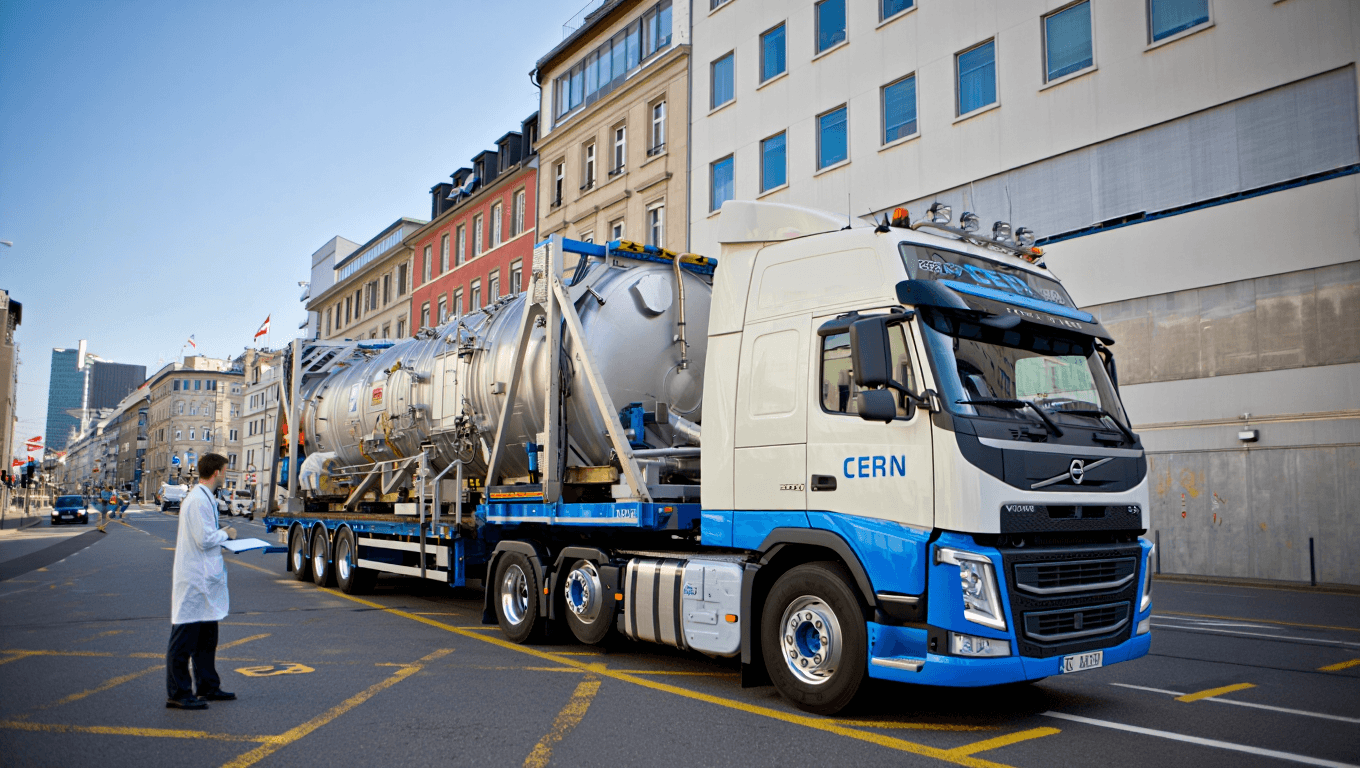
In a striking blend of big‑science caution and everyday transport, CERN has moved a minuscule amount of antimatter this week using a specially equipped Volvo truck. The shipment is tiny in scale but significant for experimental planning and the logistics of handling exotic materials outside laboratory walls.
Scientists routinely produce and study antimatter on site, yet occasional transfers are necessary when experiments or partners require material to be moved under controlled conditions. Moving these samples by road highlights both how fragile such material is and how robust the safety systems around it must be.
Why the transfer matters now
At stake is not a dramatic risk to the public but the smooth progress of precision physics. Small consignments of antimatter — typically a handful of charged particles or neutral atoms — are central to experiments that test fundamental symmetries of nature and probe how antimatter behaves under gravity. When researchers rely on collaborators or off‑site apparatus, secure transportation becomes an operational reality rather than a hypothetical concern.
Using a commercial vehicle such as a Volvo truck underlines a practical truth: transporting delicate scientific samples often requires adapting proven logistics solutions rather than bespoke, high‑profile methods. For labs and funders, that reduces cost and complexity while maintaining strict controls.
How such moves are handled
Transporting antimatter differs from moving ordinary hazardous goods in one crucial way: the quantities are exceptionally small and the risk of large‑scale release is essentially nonexistent. Still, protocols aim to ensure absolute containment and traceability.
Typical measures include specially designed containment vessels that preserve ultra‑vacuum conditions, continuous environmental monitoring, real‑time tracking, and layers of administrative permits and oversight. Trained technical staff accompany shipments and maintain communication with receiving teams to guarantee a smooth handover.
- Scale: amounts are microscopic — far below anything that could cause public harm.
- Containment: vacuum-sealed enclosures and redundant barriers keep particles isolated.
- Monitoring: telemetry and environmental sensors provide continuous data during transit.
- Logistics: sturdy commercial vehicles supply climate control and reliability for road transport.
- Regulation: moves follow institutional and national safety rules for unusual scientific materials.
Broader implications
Beyond the immediate experiment, this kind of shipment speaks to a maturing ecosystem for doing physics across institutions. Mobility of samples and equipment makes collaboration more flexible: smaller groups can access specialized beams or instruments without duplicating costly infrastructure.
There is also a communication challenge. For the general public, the words “antimatter” and “truck” together can sound alarming. Clear explanation — emphasizing the tiny quantities involved and the long-established safety practices — is essential to avoid misunderstanding and to build informed trust in scientific work.
Finally, practical experience with these transfers could influence future planning. Laboratories may standardize containers, vendors might develop tailored transport modules, and logistics teams will refine procedures that keep the science moving while keeping risk negligible.
In short, the recent road transfer is less an audacious stunt than a reminder: cutting‑edge physics depends on mundane but exacting logistics. The vehicle carrying that delicate cargo may look ordinary, but inside it moved much of what makes modern particle physics possible — carefully contained, closely watched, and ready for the next experiment.
Similar Posts
- CES 2023: Breakthroughs in AI and Truck Safety Steal the Show!
- DOT and FMCSA take action: 2,000 truckers and commercial vehicles off the roads
- New House Bill targets ‘chameleon carriers’ to enhance vehicle registration security: what you need to know
- DOT ramps up enforcement: CDL mill sweep reveals key compliance challenges
- $200M truck parking project stalled as shutdown threat looms: what it means for the industry

A logistics expert, Ethan shares tips to optimize supply chains and reduce freight costs in global trade.

